The hidden cost of EAC settlement, registry by registry
Where does the time go in EAC settlement? Into the same steps, repeated in every registry, and into a hidden cost that’s harder to spot.

Where does the time go in energy attribute certificate (EAC) settlement? For most teams, it goes into a short list of steps repeated in every registry: log in, check holdings, pair certificates with deals, deliver and cancel, one registry at a time, monthly or at year-end. For a back office or GO team that holds guarantees of origin (GOs) and other EACs in several registries, that repetition is the cost you can see. The more expensive cost is harder to spot: in a spreadsheet, a certificate paired with the wrong deal looks like any other row. It can stay hidden until a delivery or an audit brings it to light.
If your team settles certificates this way, you'll recognize the pattern. In this article, we walk through the five steps, show why each registry adds work of its own, explain where spreadsheets hide the costliest mistakes, and set out what changes when certificate settlement runs in one place.
In short: what EAC settlement costs by hand
- EAC settlement comes down to five steps: log in, check holdings, pair certificates with deals, deliver and cancel. Teams repeat them in every registry they hold certificates in, monthly or at year-end.
- Most European registries share the same AIB specifications in the background, but they differ in logins, security steps and export formats, and fewer than half have an API. That repetition is the cost you can see.
- The hidden cost is in pairing certificates with deals: done line by line in spreadsheets, a wrong pairing doesn't stand out until a delivery or an audit exposes it.
- Months later, proving which certificate covered which deal means rebuilding the record from exports, files and emails.
- When the steps run in one place, the team sees every registry in one overview, decides the pairings, and approves cancellations instead of preparing each one by hand.
[Not for Webflow: the blog template’s table of contents replaces this list. Don’t paste it.]
In this article
- The five steps behind every certificate deal
- Why every registry works differently
- The hidden cost: pairing certificates with deals in spreadsheets
- Which certificate covered which deal?
- What changes when the steps run in one place
- See it on your own book
- Frequently asked questions
The five steps behind every certificate deal
A deal can be agreed in minutes, often long before the certificates exist: a forward deal can sell 2027 production for delivery in early 2028, on certificates the seller expects to hold. Turning that deal into certificates delivered to a counterparty, or cancelled for a customer, takes much longer, and the work happens registry by registry. Here is what each of the five steps involves:
- Log in to each registry account, each with its own credentials and security steps.
- Check holdings and transactions, in each registry's portal or in an export in that registry's own format.
- Pair incoming certificates with the purchase or forecast they belong to, and outgoing certificates with the sale they will fulfill.
- Deliver the right volumes for each sale, transferring them to the counterparty by the delivery date.
- Cancel certificates for disclosure or for customers' claims, and keep the evidence.
The steps take time because they repeat. Most national registries issue GOs monthly, so for many teams the cycle starts again each month, and it peaks at year-end, when cancellations for disclosure pile up.
The steps also multiply with every registry. A team that holds certificates in four registries runs the five steps four times. When it enters a new market, they run once more, in a registry the team doesn't know yet.
Why every registry works differently
In Europe, most registries follow the same specifications from the Association of Issuing Bodies (AIB) in the background, but what they show their users varies. In hundreds of hours of interviews with GO market participants, we found that exports differ from registry to registry, in both format and content. For the people who settle certificates, that means:
- Separate logins and security steps for every registry account.
- Different export formats, column names and transaction statuses, which all have to be translated into the team's own format before certificates can be paired with deals.
- Different ways of working. Fewer than half of registries have an API, so in most of them transfers and cancellations are made by hand in the registry's web portal.
The knowledge of how each registry behaves usually sits with the people who use it. That holds until volumes grow, a new registry is added, or the one person who knows a registry is away when the deadline arrives.
The hidden cost: pairing certificates with deals in spreadsheets
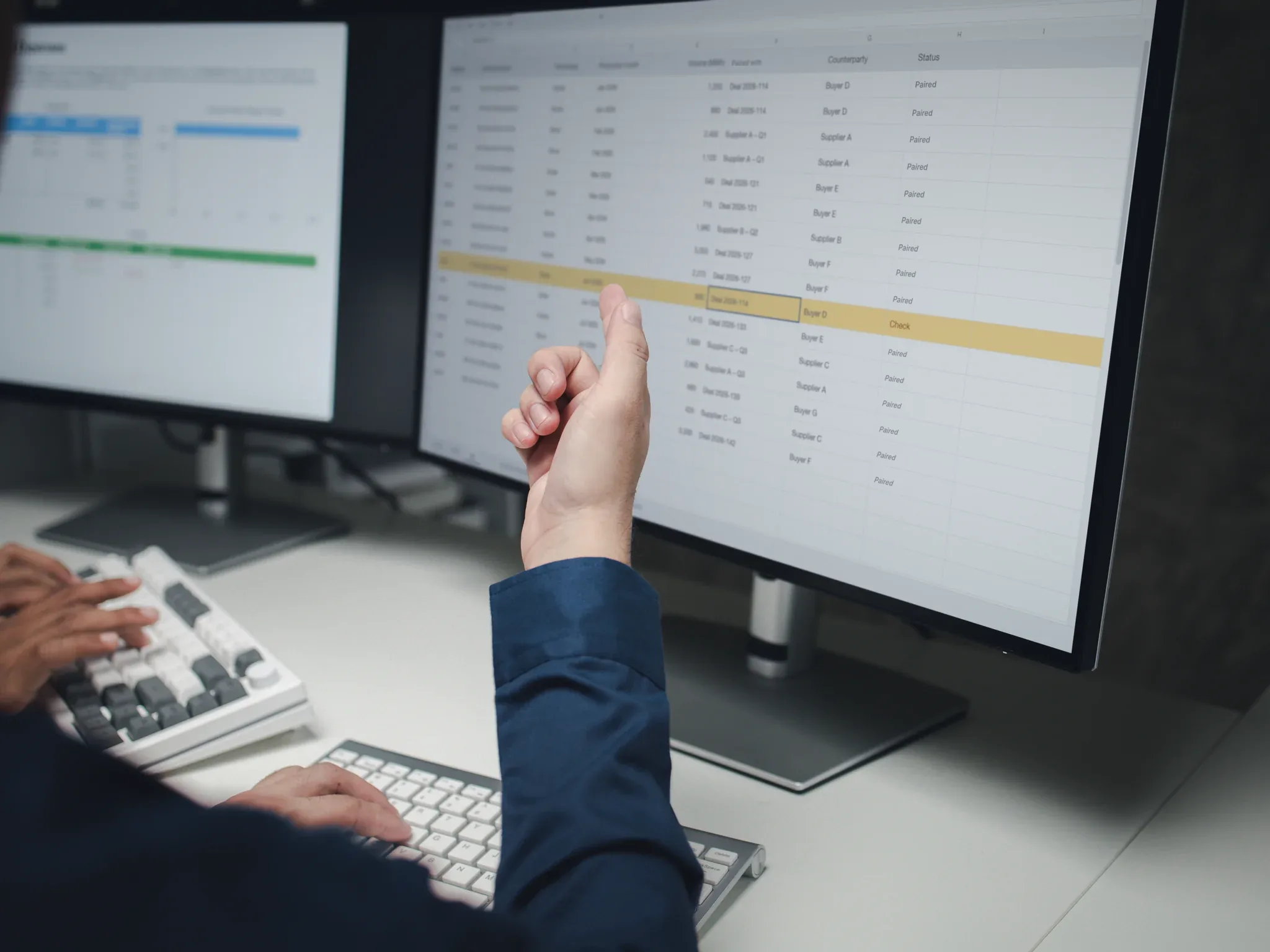
Whether it comes from an export or is copied from the portal, the data usually lands in a spreadsheet. Someone pairs certificates with trades, forecasts and customers line by line, then updates the file when a delivery is made or a plan changes.
This is where manual settlement gets expensive, because a wrong pairing doesn't announce itself. A batch from the wrong production period, paired with a deal whose buyer needs a different one, sits in the spreadsheet like any other row. Nothing turns red, and the totals still add up.
So the mistake carries on into the delivery and, in the worst case, a cancellation that can't be undone. It often surfaces late: after the delivery window, at year-end, or when someone asks for proof.
The pairing is also never finished. Traders reassign certificates when forecasts or customer needs change, and every change has to be carried through every tab that refers to it. We covered the reconciliation side of this in more detail in how to reconcile EACs across multiple registries.
Which certificate covered which deal?
Auditors ask it, disclosure depends on it, and customers ask it about their own green claims.
When settlement runs by hand, the answer is spread across registry exports, spreadsheet versions, emails and each registry's transaction history. Reconstructing it means going back through all of them, often months after the work was done, and sometimes without the person who did it.
Even when the work was done correctly, nobody can show it quickly.
What changes when the steps run in one place
Both costs grow with volume, and the volume is already large. Registries in the AIB's EECS system issued 1,091 TWh of electricity GOs in 2025, about 1.1 billion certificates, according to the AIB's annual report. That is about 30% more than in 2021, and while issuance dipped slightly last year, cancellations kept rising, to 978 TWh, equal to about 90% of the year's issuance. Every one of those certificates passes through the same steps: someone has to pair it with a deal, deliver it and, for most of them, cancel it.
CerQlar brings this work into one place, so it no longer has to be repeated by hand in every registry:
You can also keep your ETRM (energy trading and risk management system), so trades stay where they are, and CerQlar handles the registry work that follows them. Together, that is what lets a back office take on more volume and more registries without adding people at the same rate.
See it on your own book
The quickest way to see what settlement costs your team is to look at one month of it. Pick one registry and one recent month, and we'll walk you through that month in CerQlar: the overview, the pairings and the record behind each deal.
Frequently asked questions
What is EAC settlement?
Energy attribute certificate (EAC) settlement is the work that follows a certificate deal: logging in to the registry, checking holdings, pairing certificates with the deals they belong to, delivering volumes to counterparties, and cancelling certificates for disclosure or customers' claims. Guarantee of origin (GO) settlement is the same work for GOs, done in national registries, monthly or at year-end.
Why does certificate settlement take so long?
Mostly because of repetition. The same five steps have to be done in every registry a team uses, and each registry has its own logins, security steps and export formats. Pairing certificates with deals is usually done in spreadsheets, line by line, which takes time and lets errors go unnoticed.
Do all GO registries have an API?
No. Fewer than half of registries have an API. For the others, keeping records in line means manual exports, cross-checks and re-keying the same data in two places. CerQlar's Registry Bridge gives API-like access to registries without an API, so their holdings and transactions sync into the same overview as every other registry.
Do we need to replace our ETRM to use CerQlar?
No. Your trades stay in your ETRM. CerQlar handles the registry work that follows them: the overview, pairing, deliveries, cancellations and the record.
Meet the author
Martin Edling Andersson joined the founding team of CerQlar in 2020 and is now Managing Director, During this time, Martin has led the development of the CerQlar platform from concept to a platform that is now handling multi-party transactions across the world. Before joining CerQlar, Martin held multiple senior Product Leadership roles at Elsevier. He holds degrees in Human Computer Interaction and Informatics from Uppsala University and Lund University respectively.