Registry Bridge connects Pronovo ahead of quarterly labeling
Registry Bridge now connects Pronovo: Swiss holdings and transactions in CerQlar's inventory, synced every morning and on demand, ahead of quarterly labeling in 2027.

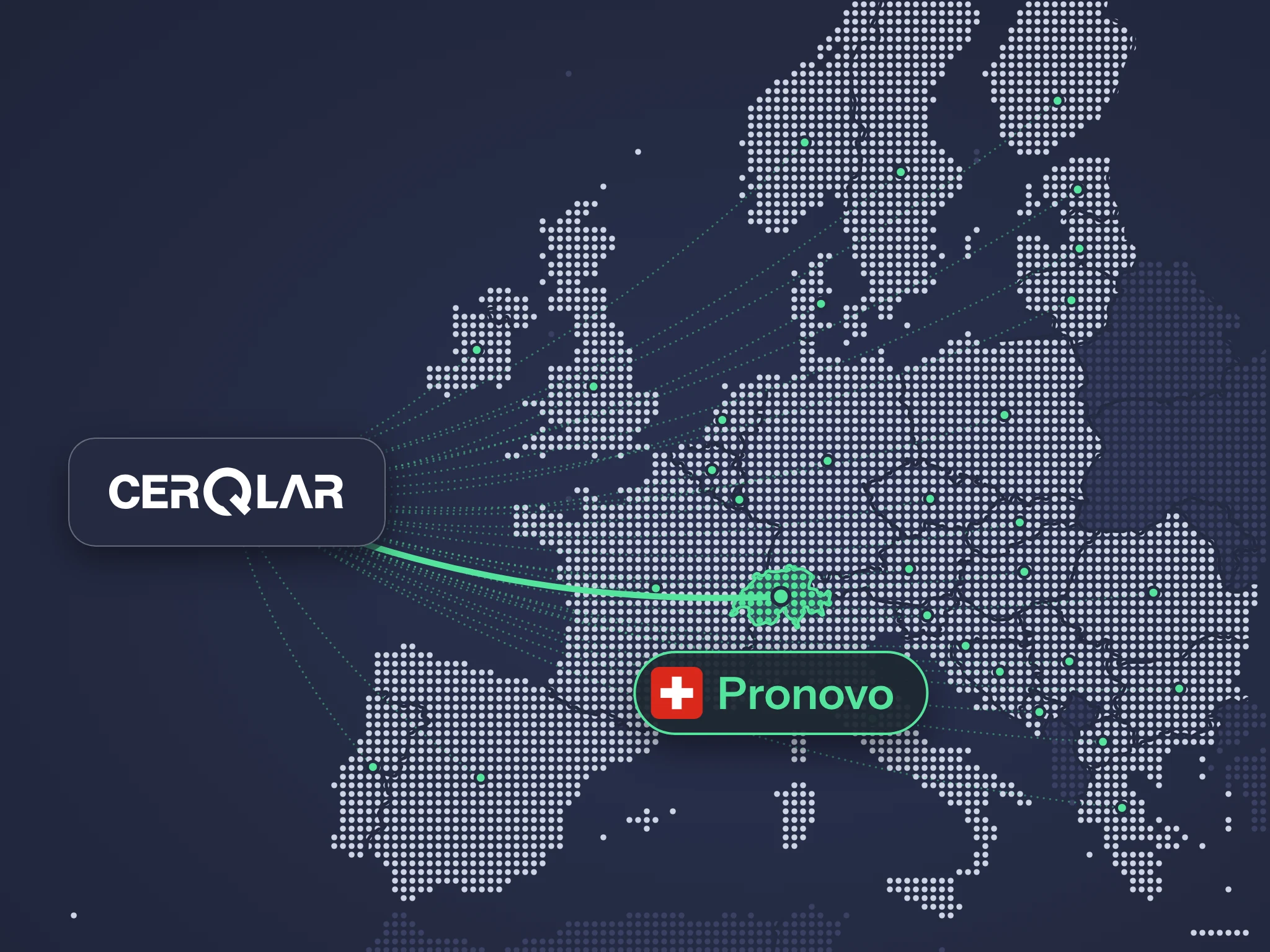
From today, CerQlar's Registry Bridge also connects to Pronovo, the Swiss registry for guarantees of origin (GOs). Teams could already add their Swiss GOs to CerQlar by hand, and had to update them the same way. But now, the holdings and transactions in a Pronovo account stay up to date in CerQlar's inventory, just like those in your API-enabled registries.
The timing matters more than usual. From the 2027 delivery year, Swiss electricity labeling is due to move from annual to quarterly. For anyone holding Swiss GOs, that makes the production quarter of each holding part of every sale for Swiss labeling from 2027.
Swiss labeling goes quarterly in 2027
Switzerland has no residual mix. All electricity consumed there has to be proven by GOs, so every Swiss supplier needs them for its labeling. Until now, the check that mattered for its purchases was the production year: only GOs produced in a given year can be used to disclose that year's electricity.
The revised Swiss ordinance on guarantees of origin and electricity labeling (HKSV) narrows that check to the quarter. From the 2027 delivery year, electricity supplied in a calendar quarter can only be labeled with GOs issued for production in that same quarter (HKSV, Annex 1, point 2.1). Today, GOs from July can cover a customer's consumption in January; from 2027, January needs GOs from the first quarter. Suppliers will still publish their labeling once a year, and they can still cancel the GOs for all four quarters at the same time after the labeling period, booked quarter by quarter.
The change was decided in 2023 and deferred to 2027 to give the market time to adjust. Because labeling has to be done by quarter from then on, the same revision ends annual GOs for small plants of up to 30 kVA; only plants without automated meter data keep them for a transition period. In March 2026, the Swiss Federal Office of Energy published the accounting template for quarterly labeling, and the revision is due to take effect on 1 January 2027, a few weeks from now.
What the quarterly rule changes for a Swiss book
For anyone who holds, buys or sells Swiss GOs, the buyer's check moves from the year to the quarter. That changes the work in three places.
Quarters stop being interchangeable. Because a quarter's electricity can only be covered by GOs from that quarter, a supplier short of first-quarter GOs in 2027 can't use third-quarter ones, however many of them it holds. The federal government expects GOs from summer production to become cheaper and GOs from winter production more expensive. VUE, the association behind the naturemade label, has told its licensees to expect a potential shortage of naturemade GOs in the first and fourth quarters.
Deals signed years ahead need a second look. Some companies buy GOs three to four years in advance under long-term supply contracts, which is one reason the change was deferred. A contract that names only a production year leaves open which quarters the GOs will come from, and from 2027 that is what the buyer's labeling depends on. So for a seller, every open Swiss deal for 2027 and later raises two questions: which quarters it will be delivered from, and whether the holdings to cover those quarters are in place. Shorter forward deals raise the same two questions, since they often sell production that doesn't exist yet, as we noted in our piece on the hidden cost of EAC settlement.
Next spring, both regimes run side by side. GOs from January to April production stay valid until the end of May of the following year, and suppliers have until the end of June to complete their labeling for the previous year. Early-2026 GOs kept in Switzerland can therefore still serve 2026 labeling well into 2027. In April 2027, a desk can get a request for 2026 GOs to close a supplier's annual 2026 labeling, while the same supplier is already counting its 2027 deliveries quarter by quarter. Answering both means knowing what is still in the Swiss account to sell, and how it sits next to everything else the company holds.
What CerQlar’s Registry Bridge brings in from Pronovo
CerQlar's Registry Bridge gives you API-like access to registries that don't have an API, with an on-demand sync. For a desk with GOs in several countries, that puts the Swiss account next to the others. A request for first-quarter GOs can then be weighed against the holdings in the company's other connected registries, without an export to start from. Each holding comes in with its production period, so first-quarter GOs in the Swiss account can be filtered and assigned next to first-quarter GOs everywhere else.
With Registry Bridge, CerQlar keeps two things from your Pronovo account up to date, near-live:
- Holdings: the GOs currently in the account.
- Transactions: the history of transfers into and out of the account.
They sit in CerQlar's inventory with the other registries your team has connected, through an API or through Registry Bridge. When you want the latest Swiss figures, you start a sync from the inventory. They also sync automatically every morning. Each sync brings in the transactions since the last completed one, so the history stays complete even after a few quiet days, and a quarter's Swiss movements can be read back in CerQlar.
For teams that keep their Swiss figures in a spreadsheet, there is no longer a separate Pronovo file to update by hand. Teams working from an ETRM keep their trades there, with the Pronovo holdings and transactions in CerQlar's inventory beside their other registries. Where reconciliation across registries tends to go wrong, and how to avoid it, is set out in our reconciliation guide.
What happens in Pronovo itself
Registry Bridge brings information into CerQlar. Transfers, acceptances and cancellations are done by your team in Pronovo, and a few Swiss rules there decide what the next sync shows.
A national transfer in Pronovo has to be accepted within 20 calendar days, or it is rejected automatically and the GOs return to the sender, where they show up again among the holdings. That window matters most in May. For GOs from early 2026, which expire at the end of May 2027, a transfer accepted late in the month leaves the buyer little time to cancel them. Once GOs expire, they can no longer be used for labeling at all. Pronovo emails the account's main contact before that happens, and the Swiss Federal Office of Energy has reminded suppliers to make sure the right email address is on file.
Cancellations are started by the account holder, and Pronovo refuses a request filed under the wrong cancellation purpose. A refused request would have to be filed again, which is one more reason not to leave cancellations for the previous year's labeling until just before last year's early GOs expire at the end of May.
Exports move whole megawatt-hours only. Pronovo issues one GO per kilowatt-hour and bundles 1,000 of them from the same plant and month into one MWh for a transfer through the AIB Hub, so the remainder of each plant-month stays in the Swiss account. Once a cancellation or an export has gone through, the GOs leave the account, and the holdings in CerQlar show it from the next sync.
Adding Registry Bridge for Pronovo to CerQlar
Registry Bridge is an add-on, set up per registry. Teams already using CerQlar can ask their account manager to add a Registry Bridge for Pronovo. If you don't use CerQlar yet, book a demo, and we'll show you Swiss holdings in CerQlar's inventory next to your other registries, and how a sync brings them up to date, before the first quarterly year begins.
Frequently asked questions
What is Pronovo?
Pronovo AG runs Switzerland's guarantee of origin system for electricity, as well as the Swiss system for renewable fuels. It is the issuing body for EECS GOs in Switzerland, and Swiss GOs move to and from other EECS registries through the AIB Hub. Plants above 30 kVA in Switzerland, nuclear and conventional ones included, have to be registered in its system.
What changes in Swiss electricity labeling in 2027?
From the 2027 delivery year, Swiss labeling moves from an annual to a quarterly basis, under the revised ordinance on guarantees of origin and electricity labeling (HKSV). Electricity supplied in a calendar quarter can then only be labeled with GOs issued for production in the same quarter. Suppliers still publish their labeling once a year.
How long does a counterparty have to accept a transfer in Pronovo?
National transfers and international imports in Pronovo have to be accepted by the receiving account within 20 calendar days. If they aren't, they are rejected automatically and the GOs go back to the sending account, where they can be transferred again.
What happens to leftover kilowatt-hours when Swiss GOs are exported?
They stay in Switzerland. Exports are bundled per plant and per month, 1,000 kWh to one MWh, and leftover kilowatt-hours can't be rounded up or carried into the next month's bundle. A holding of 3,500 kWh from one plant and one month can therefore be exported as 3 MWh, while the remaining 500 kWh stay in the Swiss account, where they can still be used for Swiss labeling.
What does Registry Bridge sync from Pronovo?
The holdings and transactions of your Pronovo account, meaning the GOs in the account and the history of transfers into and out of it, stay up to date in CerQlar's inventory. They sync automatically every morning, you can start a sync whenever you need the latest figures, and each sync brings in the transactions since the last completed one. Transfers, acceptances and cancellations are done by your team in Pronovo. Registry Bridge is an add-on to CerQlar, set up per registry.
Meet the author
Martin Edling Andersson joined the founding team of CerQlar in 2020 and is now Head of Product Management. During this time, Martin has led the development of the CerQlar platform from concept to a platform that is now handling multi-party transactions across the world. Before joining CerQlar, Martin held multiple senior Product Leadership roles at Elsevier. He holds degrees in Human Computer Interaction and Informatics from Uppsala University and Lund University respectively.