Walloon GO accounts now sync into CerQlar
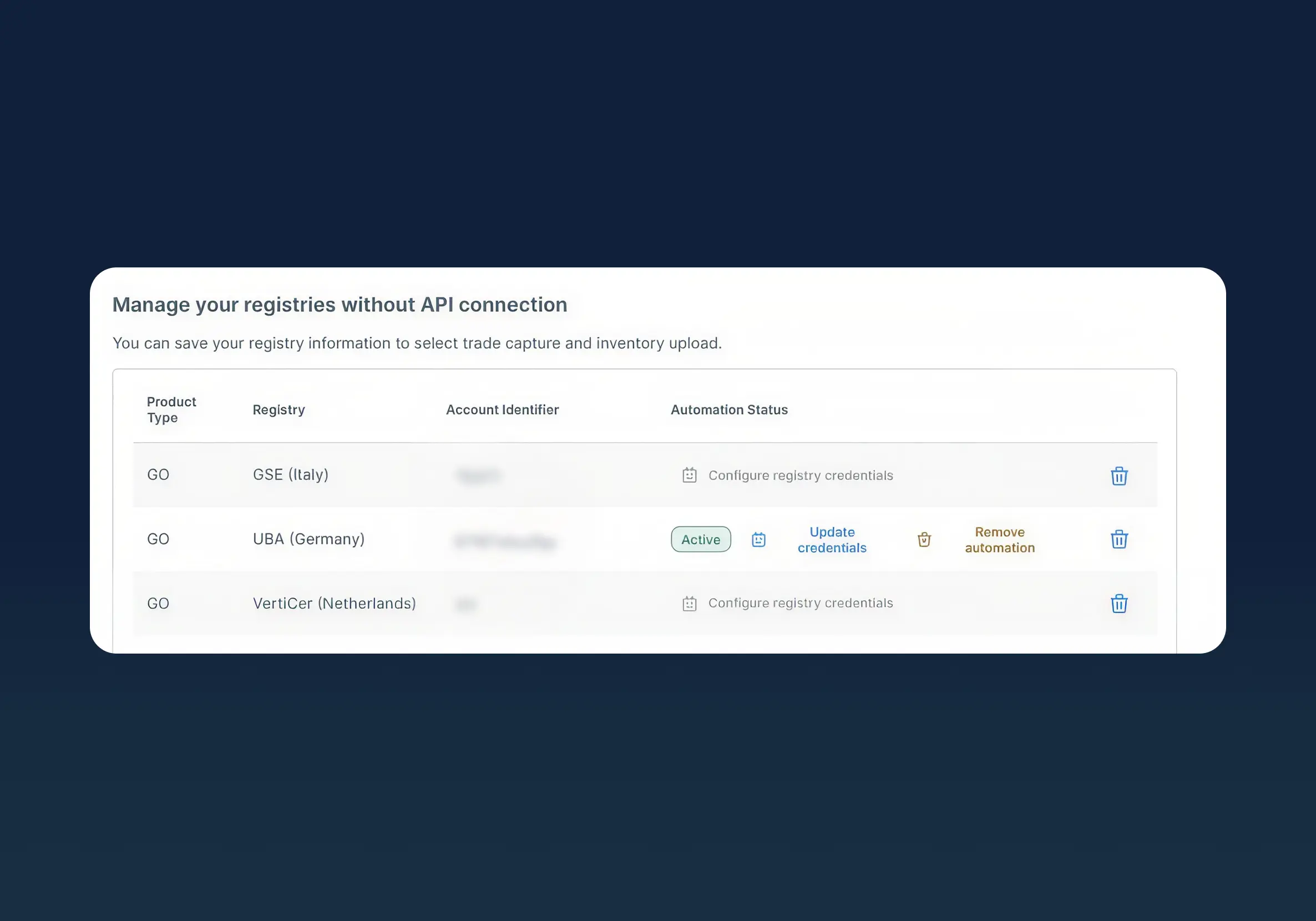
Registry Bridge now connects SPW Energie: Walloon GO holdings and transactions in CerQlar’s inventory, in the same view as your other registries.

Every month, an electricity supplier with customers in Wallonia gets a number from CWaPE, the regional energy regulator: how many guarantees of origin (GOs) to cancel for each product it has declared. The supplier has to meet that number exactly, in its account in SPW Energie's registry. And of the GOs cancelled for Walloon supply in 2024, most had been issued by other registries.
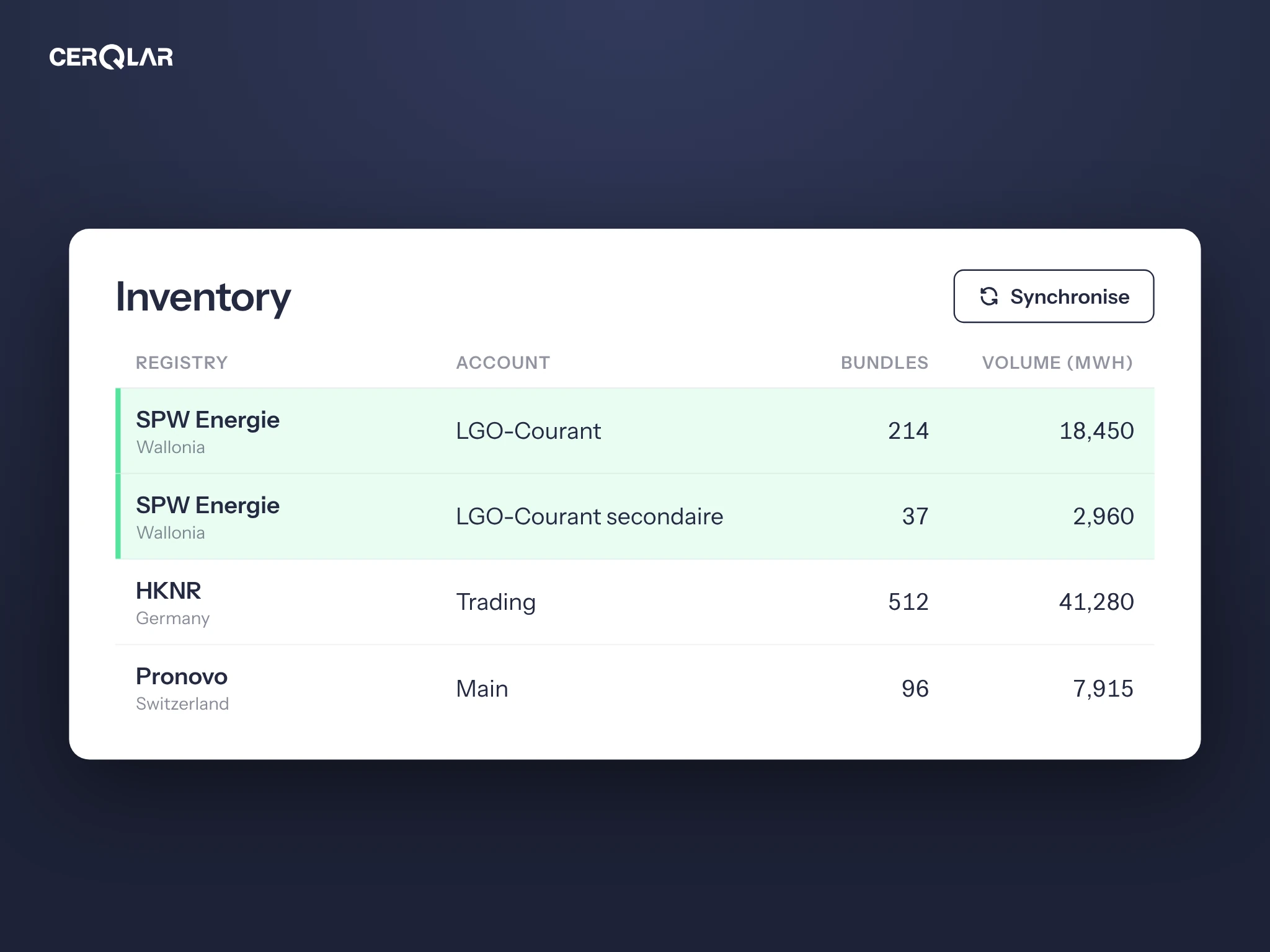
Registry Bridge, CerQlar's connection for registries without an API, now connects SPW Energie. The GO holdings and transactions of a Walloon account now come into CerQlar's inventory, in the same view as the other registries a team works in through CerQlar. For teams already using CerQlar in Wallonia, it also means no more uploading SPW files by hand.
What that changes depends on how a Walloon month runs, and on where its GOs come from.
Most GOs cancelled in Wallonia were issued somewhere else
SPW Energie's annual report for 2024 puts the numbers side by side. Of the 7.67 million GOs cancelled for suppliers' 2024 fuel mixes in Wallonia, 2.38 million, or 31%, had been issued in Wallonia. More than 2 in 3 came from other registries.
So for many suppliers, the Walloon account is where a month's GOs end up. They are bought in other markets, then imported through the AIB Hub or delivered by a trader with a Walloon account, and only then cancelled. Traders sit in the middle of that flow: GOs reach their Walloon account by import and leave it again by transfer to the suppliers who cancel them.
That means the question behind each Walloon cancellation reaches past Wallonia. Whether a month can be covered depends on what is in the Walloon account and on what is still sitting in other registries, waiting to be brought in.
A monthly number, and a quarter that closes behind it
When those GOs are needed is set by CWaPE's calendar. Green reporting in Wallonia has run month by month since January 2023. Under CWaPE's guidelines, each cancellation in SPW Energie's registry covers one calendar month and one product, under the product code the supplier declared to CWaPE. CWaPE works out the number from the green reporting data that suppliers and grid operators send it, so it arrives about 2 months after the month it covers.
The quarter, though, closes with the last of those numbers. Once a supplier has cancelled for the last month of a quarter, that quarter's data can no longer be changed, and CWaPE validates the quarter's cancellations as a whole.
That is why the count has to be exact in both directions. Cancel too few, and a product's green claim isn't fully covered. Cancel too many, and CWaPE may, as an exception, count the surplus toward the same product in the following quarter, but only until that quarter is validated; if the product no longer exists by then, the extra GOs are lost. Shortfalls do happen. At the end of April 2024, CWaPE found that several products were still short for the 2023 fuel mix, and it gave the suppliers concerned until 14 June to make up the 902 GOs that were missing.
On top of the months sit 3 deadlines:
- the fuel mix declaration for the previous year, due to CWaPE by 31 March
- the cancellations for that year's supply, within the deadline CWaPE sets and before 30 April at the latest
- the GOs' own deadline: a Walloon GO can only be transferred during the 12 months after the end of its production period
A Walloon month, seen from the back office and the desk
Take the last month of a quarter. Its figures arrive about 2 months later, product by product, and cancelling for it closes the quarter. What is already in the Walloon account covers 2 products. A third needs GOs that are still in another registry, so they have to be imported, and the count for every product has to be right the first time, because the quarter can't be corrected once that cancellation is made.
For a trader's GO desk, the same month is a delivery schedule. Suppliers' accounts need their GOs before that cancellation, and every delivery has to come from GOs that are still within their 12 transferable months. In SPW Energie's registry, a transfer to another Walloon account needs no acceptance from the receiving side, so once the desk sends it, the delivery is done. Exports out of Wallonia take longer to settle: SPW Energie's registry shows them as exported until the receiving registry answers, and GOs from a rejected export return to LGO-Courant. The planning question is which registry the GOs for each Walloon delivery will come from.
Both questions need the same picture, and SPW Energie's registry shows only part of it: one Walloon account at a time. The GOs meant to cover the month sit in other registries, each in its own interface, and the Walloon holdings had to be exported and uploaded before they could stand next to them.
The Walloon account, in the same view as the rest
That is the gap Registry Bridge now closes for SPW Energie. It brings in data from an SPW account's comptes-titres: LGO-Courant and, where available, all of its LGO-Courant secondaires. Green certificates (certificats verts), the certificates of Wallonia's support scheme, are kept in their own comptes-titres in the same registry and aren't part of the sync.
Each sync brings in:
- the full, current GO holdings of these comptes-titres
- the GO transactions since the previous sync: deliveries that came in, transfers that went out, and the other transactions on these comptes-titres
Every holding and every transaction is marked with the compte-titre it belongs to, and where 2 syncs overlap, no transaction is counted twice. Each holding also shows its production period and expiry date, so GOs close to the end of their 12 transferable months are easy to spot.
Getting started is a one-off. Your transaction history is loaded once during onboarding, and from then on a sync takes the place of the manual upload.
For SPW Energie, Registry Bridge reads and syncs. GOs move only in SPW Energie's registry, where your team makes transfers, exports and cancellations, and the next sync shows their result in CerQlar.
What changes is the moment of decision. When a month's figures arrive, one sync from the inventory puts the current Walloon holdings in the same view as the holdings in your other connected registries. Walloon accounts also sync automatically every day, and the Synchronise dialog shows when each sync last completed. Registry Bridge also connects other registries without an API, such as Pronovo and HKNR, so a team that has connected them as well can see those GOs alongside its Walloon account.
For the supplier in that quarter-end month, the third product becomes a question answered in one place: how many of the GOs it needs are already in the Walloon account, and which connected registry holds the rest. For the trader, the GOs for the next Walloon delivery can be checked in the Walloon account and in the connected registries they would come from. Once a delivery leaves, it shows up as a transaction out of its compte-titre, and an export that came back shows up among the holdings again.
Bring a Walloon month to a demo
Registry Bridge is an add-on, set up once for each SPW account. If your team already uses CerQlar, your account manager can add SPW Energie. If you don't use CerQlar yet, book a demo and we'll walk you through a Walloon month in CerQlar's inventory, in the same view as the other registries you work in.
Frequently asked questions
How often do suppliers cancel GOs in Wallonia?
Every month. Under the green reporting process CWaPE introduced in 2023, suppliers cancel GOs in SPW Energie's registry for one calendar month and one product at a time, in the number CWaPE communicates. Once a supplier has cancelled for the last month of a quarter, that quarter's data is closed, and CWaPE validates it. GOs for the previous year's supply have to be cancelled before 30 April at the latest, and the fuel mix declaration is due to CWaPE by 31 March.
What happens if a Walloon supplier cancels too many or too few GOs?
A shortfall leaves part of a product's green claim uncovered, and CWaPE can require the missing GOs to be made up, as it did for the 2023 fuel mix. A surplus can, as an exception, be counted toward the same product's cancellations in the following quarter, until that quarter is validated. If the product no longer exists, the surplus is lost.
Is SPW Energie's registry the one CWaPE used to run?
Yes. On 1 May 2019, SPW Energie, the energy department of the Public Service of Wallonia, took over the management of green certificates and the GO registry from CWaPE. CWaPE kept the approval of suppliers' fuel mixes and green reporting. SPW Energie issues EECS GOs for Wallonia as a member of the Association of Issuing Bodies (AIB).
Will GOs delivered by a counterparty show up in CerQlar?
Yes. A transfer from another Walloon account needs no acceptance in SPW Energie's registry, and the next sync brings the delivery into CerQlar's inventory, both in the holdings and as a transaction, marked with the compte-titre it arrived in.
What does Registry Bridge bring in from SPW Energie?
The GO holdings and transactions of an SPW account's comptes-titres: LGO-Courant and, where the account has one or more, its LGO-Courant secondaires. Green certificates, which belong to Wallonia's support scheme, are kept in their own comptes-titres and managed in SPW Energie's registry. Registry Bridge is an add-on to CerQlar, set up once for each SPW account.
Meet the author
Martin Edling Andersson joined the founding team of CerQlar in 2020 and is now Managing Director, During this time, Martin has led the development of the CerQlar platform from concept to a platform that is now handling multi-party transactions across the world. Before joining CerQlar, Martin held multiple senior Product Leadership roles at Elsevier. He holds degrees in Human Computer Interaction and Informatics from Uppsala University and Lund University respectively.