How to reconcile energy attribute certificates (EACs) across multiple registries
In this article, we walk through two different approaches to make your reconciliation processes faster, more efficient, and less susceptible to errors.


In short: How to automate your EAC reconciliation
- Reconciling your green certificate portfolio with external registries is time-consuming and error-prone when done manually, especially if you hold certificates on more than one registry.
- By automating reconciliation with registries, you save time, reduce admin and data input errors, and maintain an accurate view of your portfolio at all times.
- For registries that have an API, CerQlar pulls the data at regular intervals via API calls to ensure your certificate inventory is automatically reconciled with the registry e.g. marking certificates as delivered.
- For registries that don’t have an API, CerQlar supports the easy import of registry data with automated workflows that match registry data with your inventory data and ensure everything is reconciled.
- In 2026 CerQlar is launching Registry Bridge which will make automated reconciliation even easier (watch this space!).
Before we dive into the article, please note that we use energy attribute certificates (EACs), green certificates, and related terms interchangeably in this article, but for clarity we’re talking about certificates in any registry or market that are generally used to represent 1MWh of electricity generated from renewable or low carbon sources. This includes guarantees of origin (GO) in the EU, renewable energy certificates (REC) in the US, renewable energy guarantees of origin (REGO) in the UK, and international renewable energy certificates (I-RECs) in many other regions.
Most energy attribute certificate traders and owners will have certificates from multiple registries in their portfolio. While this is a solid diversification strategy, it can quickly lead to double admin, frequent errors, and eat up time when it comes to managing them.
With 1.161 TWh of guarantees of origin exchanged in Europe in 2025 and the EAC market forecast to grow by 18.6% annually for the next seven years, it’s likely that more and more companies will hold such diverse portfolios. This means that efficient certificate management processes will become increasingly important to avoid OpEx costs spinning out of control, and a huge part of that will be reconciling each sub-portfolio of certificates with each specific registry.
In this article, we walk through two different approaches to make your reconciliation processes faster, more efficient, and less susceptible to errors.
What does reconciliation mean in the context of energy attribute certificates?
In this context, reconciliation means cross-checking your energy attribute certificate records, such as the delivery status, with the data on your registry account(s). Unless reconciliation is automated, there will be discrepancies between registry data and your certificate data because transactions can take a few days to appear.
For example, if you’re a Europe-based company selling a guarantee of origin (GO) to a counterparty with a delivery date of 31 March, then you need to execute the transaction on the registry to transfer the certificate from your account to their account by the delivery date. Since this can take a few hours or days, your certificate inventory records will not be reconciled with the registry until you check the registry and mark the delivery as complete.
The pitfalls of manually reconciling your EAC portfolio with external registries
Manually reconciling your certificate inventory with multiple registries is time-consuming, error-prone, and involves duplicate admin.
Labor-intensive processes
Manually reconciling certificates requires multiple steps to be taken, usually by your operations team (often referred to as mid- or back office). These steps involve frequently exporting data from your registry account, importing it into your system or files, and updating your certificate inventory accordingly.
Duplicate admin
Not only does manual reconciliation take a lot of time, but it also involves double admin from different teams who each maintain their own records rather than using a centralized database. This issue is even worse if you have different teams for different markets or registries, as typically certificate data is not recorded or stored in standard formats.
Risk of errors
When humans are involved in manually inputting and comparing data, errors are practically unavoidable. Common errors include inadvertently letting certificates expire without selling them, delivering certificates to the wrong counterparty, or incorrectly recording a certificate’s details. Certificates tend to be traded as part of large contracts so mistakes can be very costly in terms of damages, financial penalties, and your reputation.
Automated reconciliation and how it works in practice
Automated reconciliation means replacing manual processes used to reconcile certificate data against external registries, with automated workflows, APIs, and AI-powered tools. There are two main ways that you can automate reconciliations with external registries, depending on the registries that you trade or purchase certificates from.
API-enabled registries
A growing number of registries have an API to help certificate traders and owners keep their records up to date. Typically, the API sends the registry data to the user’s system (e.g. a CTRM) at fixed intervals.
The system then automatically—or sometimes manually—matches the registry data with the relevant certificates and updates the status. Exceptions and discrepancies are flagged for the user to review.
This is relatively straightforward but not all systems are capable of accurate matching of registry and certificate inventory data, and often users still have to manually adjust or validate the data e.g. confirming a certificate has been delivered before updating the status.
Registries without an API
For registries without an off-the-shelf API, companies typically need to manually export the registry data from their account in batches and then import it into their preferred systems. If they still use spreadsheets to manage their certificate inventories, then they will likely do a side-by-side comparison of the registry data and update their spreadsheet based on this.
Both of these methods involve significant manual effort, so CerQlar is launching Registry Bridge to automate reconciliation with registries, even when no API exists. Registry Bridge provides an API-like functionality by regularly reading data from your registry account, and updating your certificate inventory data in real time based on the registry.
How automated EAC reconciliation reduces costs and improves decision-making
There are many benefits of automating reconciliation with registries, but one of the most noticeable impacts is the time it gives back to your operations team. Instead of manually exporting, importing, and cross-checking registry data, your team only deals with exceptions that genuinely need human review.
It goes beyond operational cost savings, as automating reconciliation avoids common errors such as expired certificates, wrong counterparty deliveries, or mismatched inventory figures, which can damage your reputation in the market. It also helps you make better operational decisions, as you always have an up-to-date view of your portfolio.
In addition to these immediate benefits, automating reconciliation now helps you stay one step ahead of fast-approaching regulations that will require more granular reporting on EAC activities and a potential shift toward hourly matching.
Getting started with CerQlar for managing your green certificates
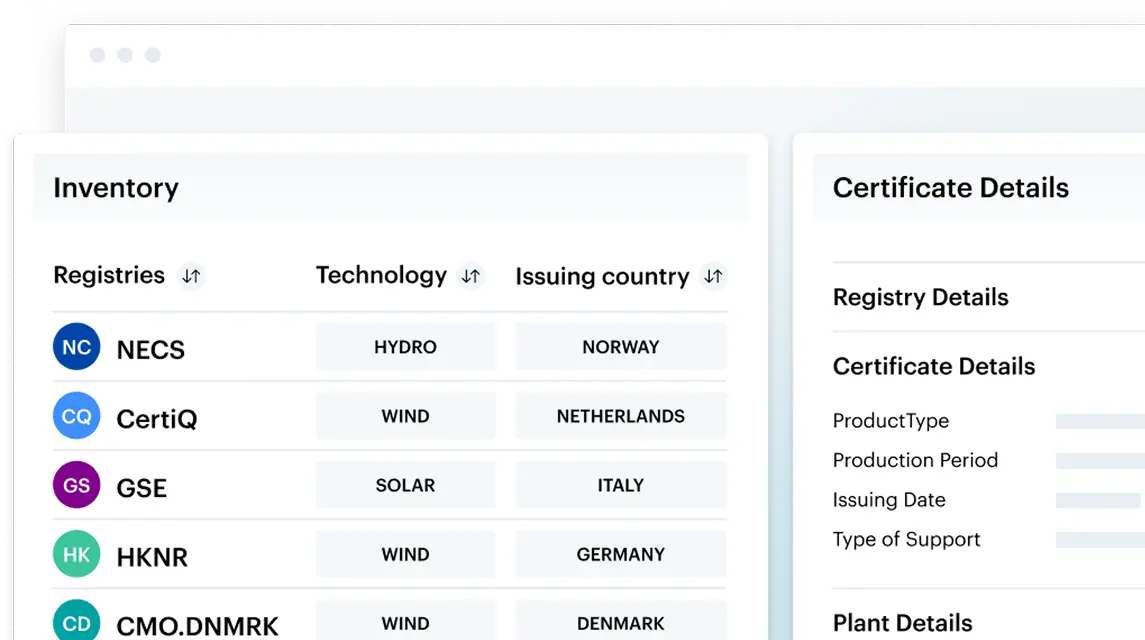
CerQlar is purpose-built for traders and owners of energy attribute certificates of any type, who need a single, accurate view of their portfolio across multiple registries. It integrates directly with 30+ registries via API where available, and supports automated reconciliation for those that don’t with Registry Bridge, ensuring you always have an up-to-date view of your inventory.
If you’d like to see how it can work for your certificate management, just book a call and we’ll be in touch.
Frequently asked questions
What is energy attribute certificate (EAC) reconciliation?
Reconciling energy attribute certificates—whether you hold guarantees of origin, I-RECs, REGOs, or other types—means cross-checking your certificate data with the data on your registry account. The main details that are checked are the certificate origin (technology type, location etc.) and the status (available, cancelled, expired etc.).
Unless reconciliation is automated, there will be discrepancies between registry data and your certificate data because transactions can take a few days to appear.
Can automated reconciliation be used for certificates of any type?
Yes. CerQlar supports automated reconciliation across all certificate types, including GOs, REGOs, RECs, I-RECs, and more. This is possible for any registry, even if the registry does not have an off-the-shelf API.
How do I reconcile different types of EACs like GOs or I-RECs?
Different types of energy attribute certificates are held on different registries, which can require repeating similar reconciliation processes multiple times when handled manually. It also requires a lot of time to standardize the data as each registry captures different details for certificates.
Automated reconciliation tools like CerQlar allow you to automatically reconcile certificates across multiple registries and standardize the data so you have a single, accurate view of your certificate inventory.
What are the main benefits of automated reconciliation?
Automated reconciliation saves time by speeding up processes that were previously manual and labor-intensive, which in turn reduces operational costs. It also makes reconciliation much more accurate by removing human input errors, and supports better decision-making by giving operations, portfolio management, and trading teams an up-to-date view of their certificate inventory and position.
Meet the author
Alex Remmerswaal is Head of Commercial at CerQlar, where he leads the company's go-to-market efforts. Alex initially joined CerQlar in July 2023 as a Senior Enterprise Account Executive and progressed through Director of Enterprise Sales before stepping into his current role in January 2026. Before joining CerQlar, Alex held enterprise sales positions at Sprinklr and Accruent. He holds an MSc. in Business Administration from the University of Amsterdam.